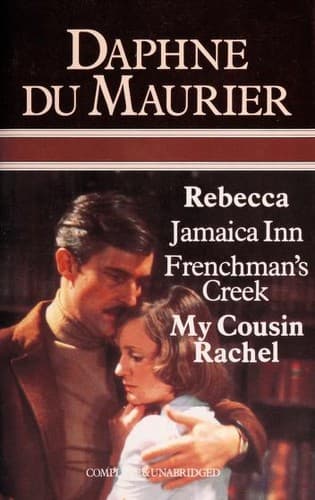
Rebecca
What is “Rebecca” about?
A young woman marries a widower and moves to the ominous estate of Manderley, where his late wife’s presence still dominates—especially through the sinister housekeeper who won’t let her memory rest.
About This Book
In Daphne du Maurier's "Rebecca," a young, unnamed woman marries the wealthy widower Maxim de Winter and relocates to his grand estate, Manderley, in Cornwall. There, she is overshadowed by the lingering presence of Rebecca, Maxim's first wife, whose memory is perpetuated by the devoted housekeeper, Mrs. Danvers. The new Mrs. de Winter grapples with feelings of inadequacy and jealousy as she uncovers unsettling truths about Rebecca's life and death.
The novel delves into themes of identity, obsession, and the haunting influence of the past. The tension escalates as the protagonist confronts the enigmatic Rebecca's legacy, leading to a series of revelations that challenge her understanding of her husband and herself. The atmosphere is dark and suspenseful, with a slow-burn intensity that builds toward a dramatic climax.
"Rebecca" is a gothic tale that masterfully intertwines romance and mystery, exploring the complexities of love, memory, and the shadows cast by a haunting past.
What Readers Say
Readers praise du Maurier's atmospheric writing that immerses them in Manderley's haunting ambiance. Many commend the novel's suspenseful plot and unexpected twists that keep them engaged. Fans note the complex characterizations, particularly the enigmatic Mrs. Danvers, adding depth to the story. Some readers find the unnamed narrator's naivety frustrating, affecting their connection to the protagonist. Content warning: The novel contains themes of psychological manipulation and emotional abuse, which may be distressing.
Rating Distribution
Based on 45 Open Library ratings
Reader Reviews
7 curated reviewsCaterpillar Girl
Dec 4, 2000
NOT A ROMANCE NOVEL
This book is a wonderful piece of literature, but it's NOT a romance novel. Du Maurier never intended it to be read is such. The main characters are married, but the story does not focus on their courtship or their relationship, rather I would say on the individuals they are. I believe that the narrator's journey from naive, innocent, childhood to aware, mature, adulthood is very important. The fact that she remains nameless throughout the story, or is referred to as Mrs. De Winter, shows how easily she initially gives up her own identity to please others: her employer, her husband, even her o
Julie A. Saffrin
Dec 9, 2001
Suspense begins with the never named narrator of this book.
And you thought you had problems. Our never-named narrator marries a millionaire twice her age, and moves back to her husband's estate, Manderley, on the coast of Cornwall, England. Soon her husband's now dead first wife, Rebecca, whose body was never discovered, begins to invisibly invade the newlyweds. If that's not enough, add Mrs. Danvers, the all-seeing housekeeper who yearns to have the original first lady of the house back in charge, and a mysterious man who surprises our narrator at every turn and you've got what you paid for: A terrific page-turning mystery. Rebecca is du Maurier at h
Eventide
Jan 1, 2009
This is a character study, not a romance or mystery really
For all of Rebecca's hype as the "modern masterpiece" of Gothic fiction, romantic suspense, etc., I think readers need to understand exactly what they will be getting with this story. I can understand people's frustration with the Second Mrs. De Winter (I wanted to slap her repeatedly too) and what they perceive as a "boring narrative pace" where nothing "happens until the last hundred pages or so," and while these are all valid points to a degree, I think they should approach the novel from a different perspective.Rebecca is first and foremost a probe into human psychology. Du Maurier herself
John P Bernat
Aug 20, 2005
Masochistic Pursuit of Wealth and Status
Made you look with that title, eh?Well, think about it: "the second Mrs. DeWinter" is never even identified by name in this book. She sucks up all the abuse heaped on her by a servant, no less, because she wants to please everyone so much.du Maurier was trying to tell us something in this great book: our own initiative, curiosity and self-worth matter so much more than what sort of birth status we have, or what we marry. In fact, you could argue that by destroying Manderley at the end, du Maurier was making the strongest possible declaration against the so-called privileges of aristocracy. Suc
Jennifer M
Dec 19, 2004
Dreaming of Manderley
When is a romance novel not a romance novel?When it's a gothic suspense thriller fairy tale romance novel, such as Daphne duMaurier's Rebecca (Victor Gollancz, 1938, republished by Avon in 1971). The book's staying power can perhaps be best explained because it combines all the trashy, page-turning suspense of modern writers like Stephen King and John Grisham without the pedestrian prose that make King or Grisham such an insult to the intellect. Rebecca is well-crafted without requiring the same kind of concentration as a modern reader would employ when tackling the heightened language of olde
Lea
Sep 13, 2004
My review won't spoil anything
It's true that most people will find the first two chapters (or more) tedious, but don't let that stop you from reading the rest. The nameless narrator (a brilliant move-- although I read that Du Maurier simply couldn't think of a name) has the truest emotions of any character in any book I've read, and I don't see how anyone can dispute it. Be careful reading other reviews on this site-- many are great, but several give inaccurate details that may send you into it with the wrong state of mind (and some even give away the plot!). Read it and enjoy. The book does move well-- but pay attention!